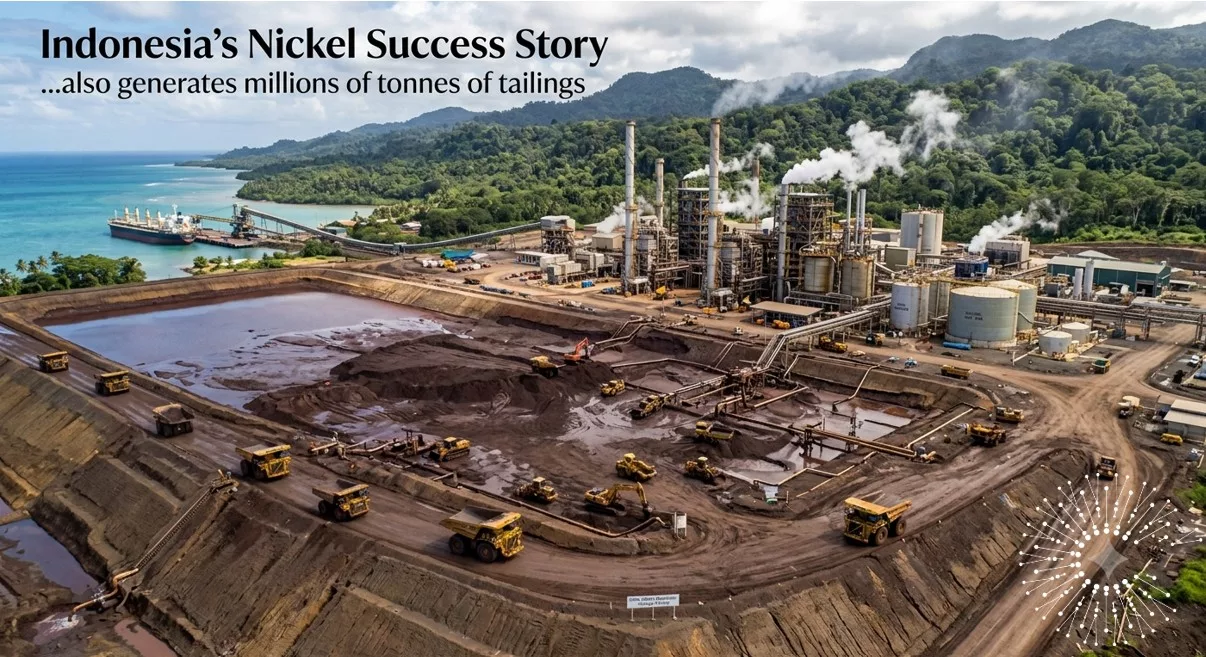
2 min read –
The Other Side of Indonesia’s
Nickel Success Story :
Nickel Tailings –
Indonesia has become the world’s leading producer of nickel.
It is an extraordinary industrial success story. But every industrial revolution comes with challenges.
A recent report from the Energy Shift Institute highlights one that deserves far more attention: HPAL tailings.
Simply put, tailings are the mineral residues left after valuable metals have been extracted from the ore.
In HPAL (High Pressure Acid Leaching), the process used to produce battery-grade nickel, these residues are generated in astonishing quantities.
According to the report, Indonesia could generate around 1.4 billion tonnes of HPAL tailings by 2035.
To put that into perspective, that is enough material to cover the entire city of Jakarta with a one-metre-thick layer.
The challenge is not only about volume.
In 2025 alone, HPAL operations already generated around 53 million tonnes of tailings, or almost twice Indonesia’s annual domestic waste.
And this industry has only been operating at large scale for a few years.
The report also points out that these storage facilities are often located close to communities and sensitive coastal ecosystems.
Combined with Indonesia’s heavy rainfall and seismic activity, this makes safe tailings management a critical challenge rather than simply an environmental consideration.
Fortunately, solutions exist.
One of the most promising approaches is dry stacking, where tailings are first dewatered before being stored.
Compared with conventional wet tailings storage, properly engineered dry stacks generally offer a safer and more stable solution.
However, their performance depends on several factors: rigorous engineering, effective drainage, continuous monitoring, and efficient dewatering.
This is where filter press technology plays an important role.
By producing a drier, more manageable filter cake, industrial filter presses help prepare tailings for safer dry-stack storage.
They are not a complete solution; safe tailings management also relies on sound engineering, operational discipline and robust regulation, but they are an essential part of the process.
At CHOQUENET, we design filtration systems for demanding hydrometallurgical applications since 1925.
As Indonesia’s nickel industry continues to expand, producing the minerals needed for the energy transition is essential. Managing what remains may prove just as important.
How do you see the future of tailings management as nickel production continues to grow? I’d be interested to hear your thoughts and experience.
We are CINTASIA, CHOQUENET‘s representative in Indonesia. If you want a copy of the insightful 37-page report by the Energy Shift Institute, feel free to contact me.
PS: Read our previous article on tailings here: Make Mining Clean At Last – Cintasia
Picture by Gemini
Source: Energy Shift Institute; Reza Rahmaditio