1,5 min read –
Opportunity in Diversity –
ASEAN by the Numbers –
What the Data Reveals
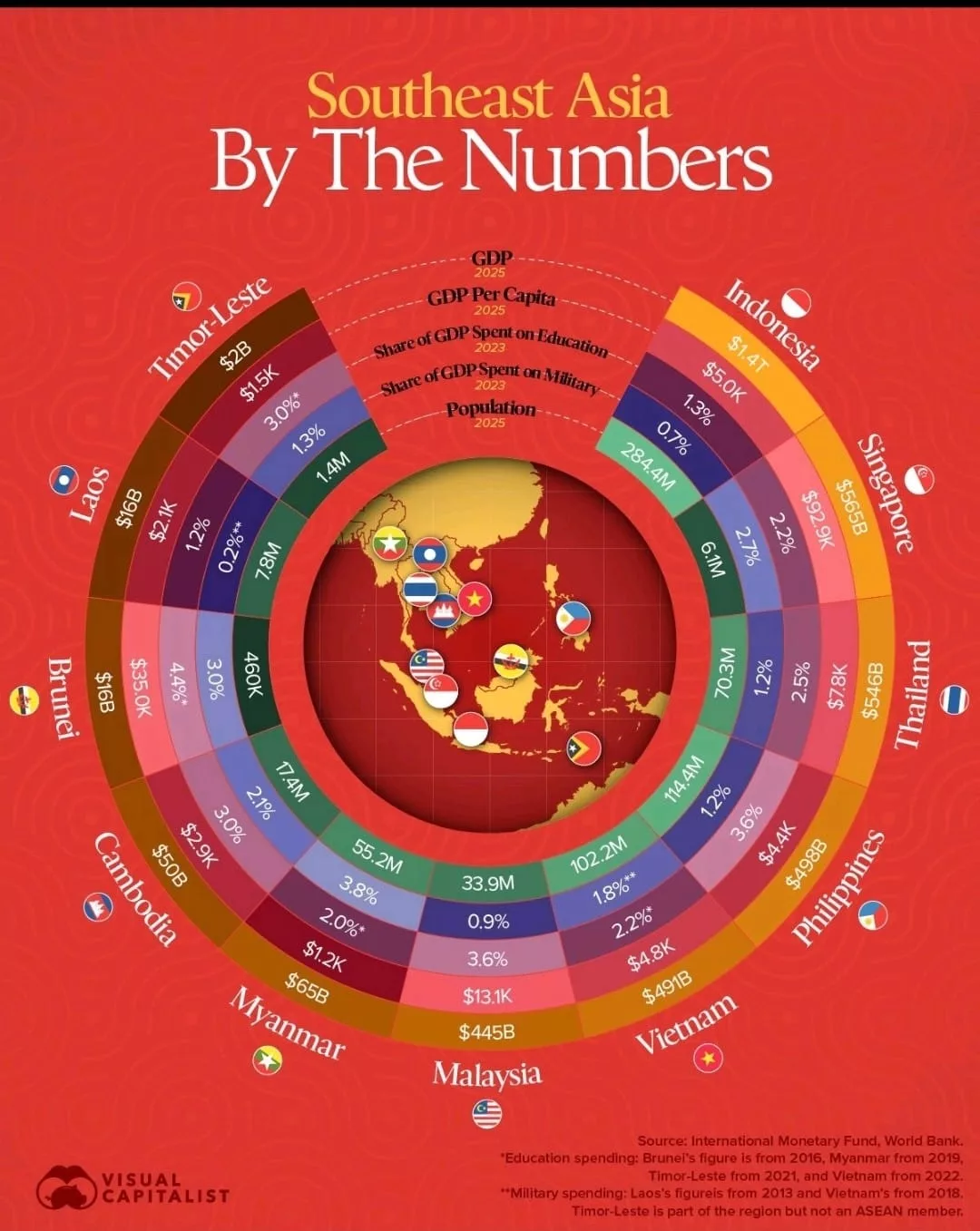
This macroeconomic snapshot of Southeast Asia highlights striking contrasts across the region.
Below is a country-by-country breakdown of key strengths and weaknesses based on :
➡️ GDP size
➡️ Population
➡️ GDP per capita
➡️ Military spending
➡️ Education spending
Indonesia
✅ Largest GDP and population by far, a massive domestic market, and regional heavyweight.
❌ Low education spending (lowest just after Laos) is reflected in the persistent shortage of qualified middle managers.
Singapore
✅ Exceptionally high GDP per capita, a regional outlier, the financial and high-tech hub of ASEAN.
✅ Small population limits scale but strengthens focus on productivity and specialization.
Malaysia
✅ Strong mid-range GDP with competitive GDP per capita.
✅ Balanced education and military spending, showing stable long-term planning.
Thailand
✅ Large economy and population, giving strong market depth.
☑️ Moderate GDP/capita, showing potential but also structural stagnation.
Philippines
✅ Fast-growing, young population, a clear long-term asset.
❌ GDP per capita remains low, indicating productivity challenges.
Vietnam
✅ High growth engine with robust GDP expansion.
☑️ Relatively low GDP/capita, but rising quickly as industrialization accelerates.
Myanmar
✅ Significant population size, offering future consumption potential.
❌ Very low education spending is a major constraint.
Cambodia
✅ Dynamic, young workforce and improving industrial base.
☑️ Low GDP per capita signals a long development road ahead.
Laos
❌ Small population and low GDP, limiting market potential.
❌ One of the lowest education spending ratios, weakening competitiveness.
Brunei
✅ High GDP per capita, driven by energy wealth.
☑️ Very small population, creating a niche but limited market.
Timor-Leste
☑️ Tiny economy, early-stage development.
❌ Low education spending, limiting human-capital growth.
ASEAN is not one market, but 11 distinct countries with radically different sizes, incomes, and capabilities.
If you export or want to export to ASEAN, you should:
🔸Adapt positioning to income levels and education depth.
🔸Prioritize Indonesia, Vietnam, Malaysia, and the Philippines for scale.
🔸Work with strong local partners who can navigate regulatory complexity and cultural differences.
This ASEAN diversity is a challenge, but also the region’s greatest opportunity.
We are CINTASIA, and we help you develop your sales and operations successfully in Indonesia.
We specialize in technology and industrial equipment.
PS: If you enjoyed this article, check out our blog for more. We have published 160+ other articles.
Go to https://cintasia.com/news-insights/
Picture and source: Visual Capitalist