2 min read –
Can a private company downgrade a country?
MSCI Versus Indonesia –
Part 2: Our 2 cents –
An index downgrade cannot make Indonesia’s resources disappear.
Nor can it erase its domestic market, workforce, factories or infrastructure needs.
Following my previous post on MSCI last week, here is my position: I remain firmly in Indonesia’s corner.
That does not mean dismissing concerns about opaque ownership or suspected market manipulation.
Indonesian investors deserve transparent markets.
They also deserve a debate that does not treat “emerging” as a synonym for suspect and “developed” as a certificate of virtue.
If transparency and market integrity are the standards, investors should demand that scrutiny everywhere, including in the United States.
How consistently are those standards applied, and how clearly are differences in treatment explained?
Reform is in Indonesia’s own interest. But we should challenge the leap from “MSCI may reclassify Indonesia” to “Indonesia’s economic story is broken.”
MSCI assesses whether international investors can reliably access and invest in a stock market. That is important. It is also narrower than assessing a country’s productive potential.
Indonesia’s economy grew 5.47% year on year in the third quarter of 2026, according to Bank Indonesia.
Domestic consumption and investment helped drive that expansion.
An index announcement cannot automatically reverse those activities.
It can, however, trigger portfolio outflows, weaken share prices and add pressure to the currency. If sustained, those pressures could raise financing costs and affect investment. Resilience does not mean immunity.
Now for the uncomfortable question: who benefits when benchmark-driven investors sell?
Investors with flexible mandates and available capital may find cheaper assets. Indonesian, American, other Asian and European investors can all potentially participate.
MSCI’s American nationality alone does not establish coordination with Washington.
Nevertheless, asking how private financial infrastructure concentrates influence over national markets is legitimate.
Who writes the rules? Who pays for them? Who must sell when classifications change? And who remains free to buy?
For Western industrial exporters, the distinction matters: portfolio volatility and demand for equipment, energy or infrastructure do not move together.
My conviction is that Indonesia should improve its markets without allowing an external classification to define its economic ambition.
MSCI’s consultation closes on 30 April 2027; decision due by 30 June 2027.
What do you expect: a financial shock spilling into the real economy, or a difficult adjustment followed by continued growth and resilience?
I favour the latter. If you already follow me, my optimism about Indonesia will come as no surprise. 😊
At CINTASIA, we help technology and industrial equipment companies grow their sales and operations in Indonesia.
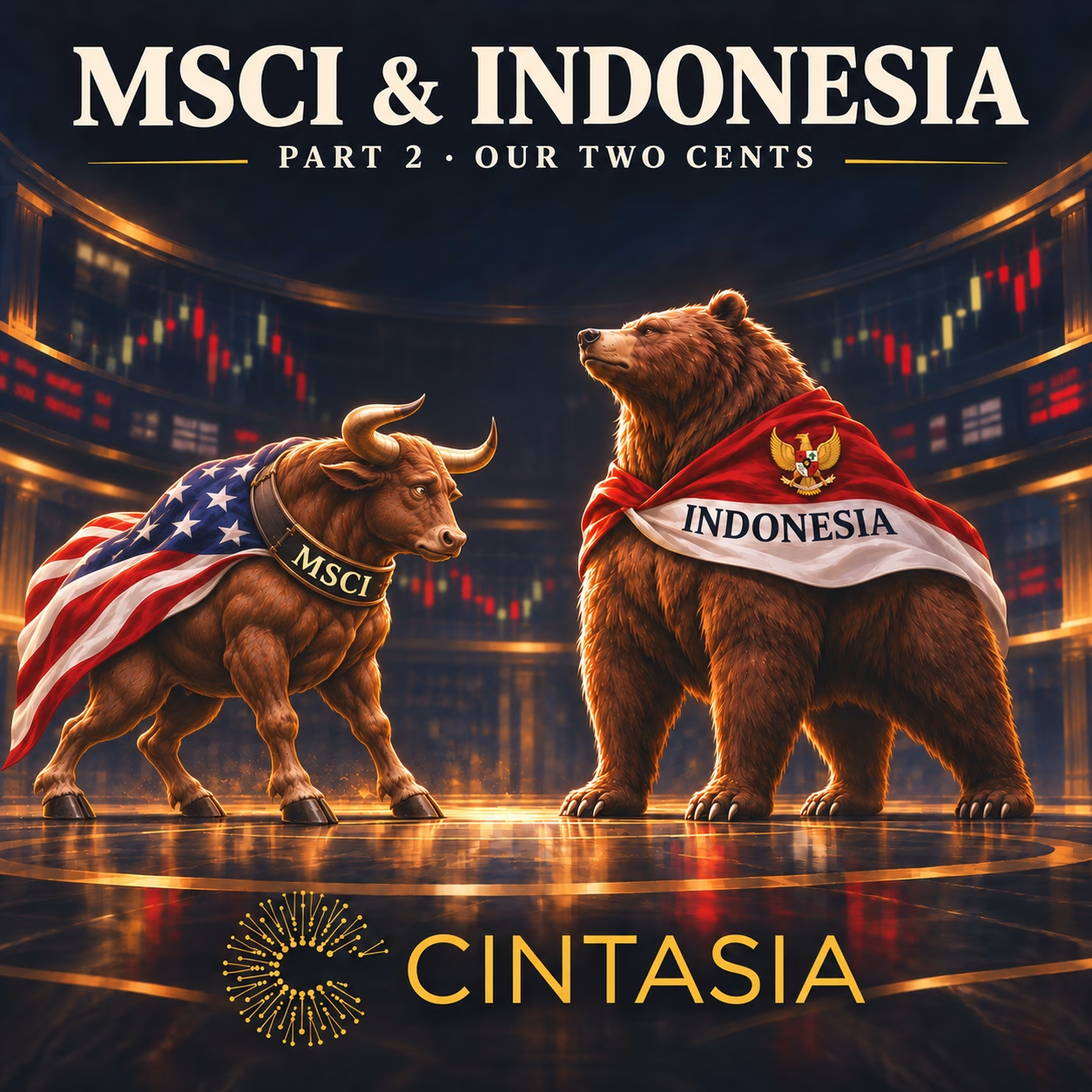
Picture by Cintasia with ChatGPT