2 mind read –
Cintasia Summer Mini-Series 2026 Edition –
Money, Politics & Technology –
Episode 2 –
This summer, let’s take a short break from industrial topics to explore one fundamental question shaping our world.
In this edition we discuss over 4 short episodes :
• Episode 1 – Why Indonesia’s Central Bank Governor Resigned
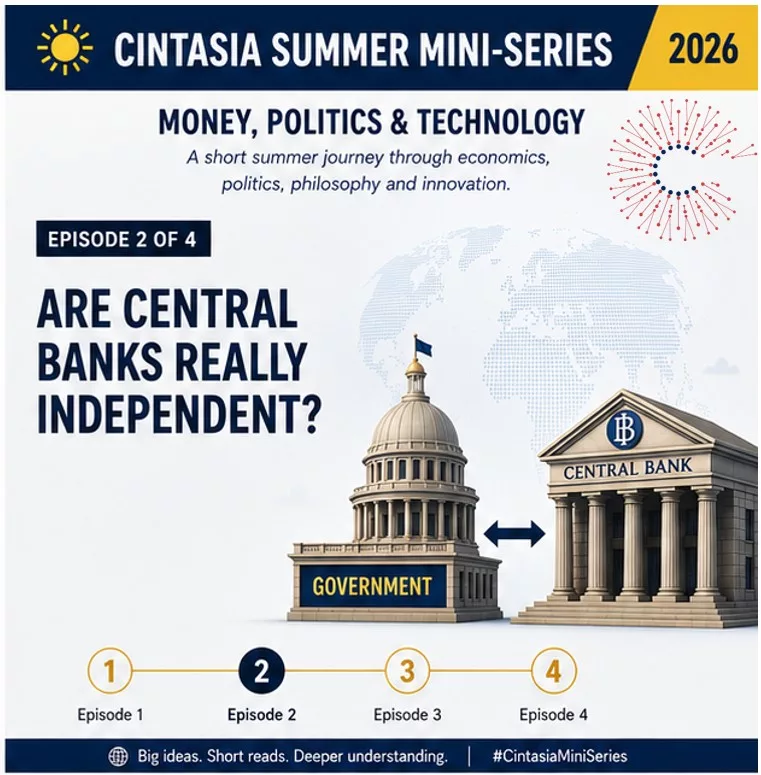
• Episode 2 – Are Central Banks Really Independent?
• Episode 3 – Should Money Be Separated from the State?
• Episode 4 – The Technology That Changed Money Forever.
⬇️ Episode 2
Are Central Banks Really Independent?
Last week, we explored what central banks are and why they matter.
Officially, most modern central banks are designed to operate independently from governments.
The idea is simple: politicians naturally think in election cycles, while monetary policy requires long-term discipline.
In theory, this independence protects economies from excessive money creation, political pressure, and short-term decision-making.
Reality, however, is different.
The U.S. Federal Reserve regularly faces public pressure from presidents.
Before the creation of the euro, the Banque de France operated under much closer government influence.
Even the European Central Bank, one of the world’s most independent institution (supposely), must constantly balance the often conflicting interests of 20 member states.
In Indonesia, every appointment or unexpected departure at Bank Indonesia inevitably raises questions about the relationship between monetary policy and political priorities.
Economists themselves remain divided.
Monetarists, led by Milton Friedman, emphasized strict control of the money supply to preserve price stability.
The Austrian School, represented by Friedrich Hayek and Ludwig von Mises, went even further, arguing that governments should have little, or no control over money creation.
On the other hand, Keynesian economists generally accept a more active role for central banks and governments, particularly during recessions and financial crises.
Some economists argue that increasing political influence over money creation contributes to economic instability, excessive debt, asset bubbles, and even geopolitical tensions.
Others strongly disagree, believing that active monetary policy is essential to stabilize modern economies.
Look at the current state of the world; does it seem more chaotic or more stable?
Are you Team Keynes or Team Hayek?
Whatever your opinion, one question naturally follows:
If separating political power from money is so difficult… should money itself be separated from political power?
That will be the topic of next week’s article in episode 3.
We are CINTASIA, and we help you develop your sales and operations successfully in Indonesia.
We specialize in technology and industrial equipment.
PS: We have published nearly 200 other articles.
Go to https://cintasia.com/news-insights/