2 min read –
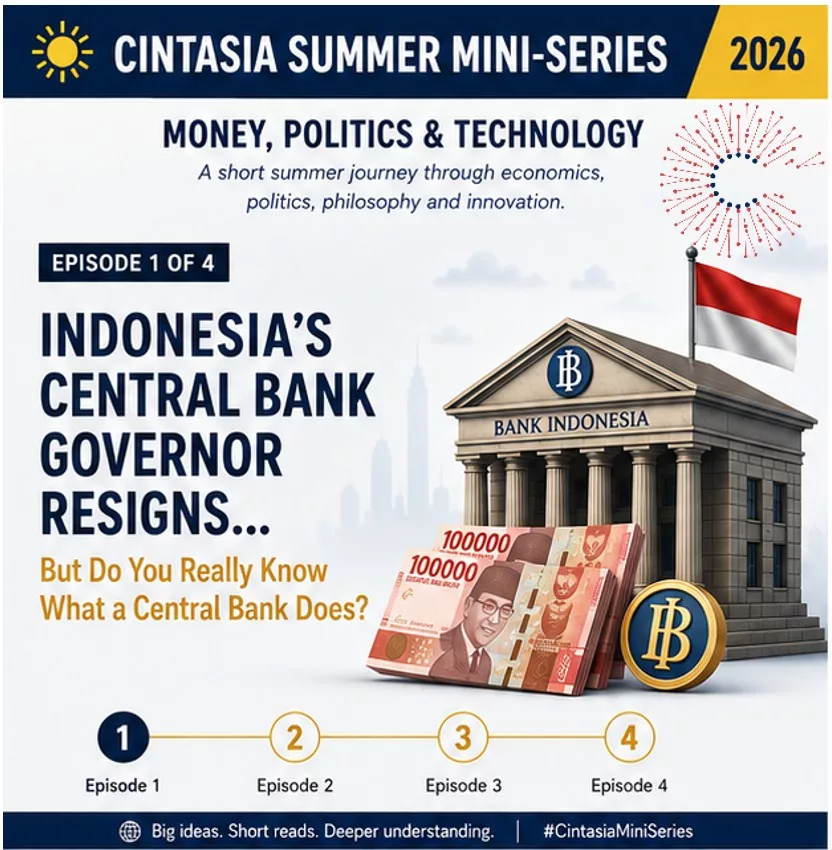
Cintasia Summer Mini-Series 2026 Edition –
Money, Politics & Technology –
Episode 1 –
This summer, let’s take a short break from industrial topics to explore a fundamental question that shapes our world.
In this edition, we discuss over 4 short episodes :
• Episode 1 – Why Indonesia’s Central Bank Governor Resigned
• Episode 2 – Are Central Banks Really Independent?
• Episode 3 – Should Money Be Separated from the State?
• Episode 4 – The Technology That Changed Money Forever.
⬇️ Episode 1
Indonesia’s Central Bank Governor Resigns.
But Do You Really Know What a Central Bank Does?
The recent resignation of Perry Warjiyo, Governor of Bank Indonesia, on 27 July 2026, surprised financial markets and immediately sparked questions about the country’s monetary future.
Governor since 2018, Perry Warjiyo played a key role in navigating Indonesia through the COVID-19 crisis, global inflation, and a period of significant exchange-rate volatility.
While the official explanation for his resignation was personal, observers have naturally wondered whether political factors also played a role.
Whatever the reason, leadership changes at a central bank are never ordinary events: they influence market confidence, expectations, and sometimes even the value of a nation’s currency.
But this raises a more fundamental question.
What exactly is a central bank?
For thousands of years, civilizations, including Ancient Greece, Ancient Rome, medieval Europe, the Islamic world, and imperial China, had money without central banks.
The first modern central bank, the Bank of England, was created in 1694, primarily to help finance the English government’s war against France by managing public debt and issuing banknotes.
Over time, the institution evolved into a central bank with broader monetary responsibilities.
Over several centuries, most countries established their own central banks with three primary missions:
➡️ maintain price stability
➡️ preserve confidence in the financial system
➡️ and act as lender of last resort during crises
Today, central banks influence our daily lives more than most people realize.
They adjust interest rates to control inflation, regulate commercial banks, manage foreign exchange reserves, and expand or contract the money supply through monetary policy.
During major crises, they create money electronically to purchase financial assets, a process known as Quantitative Easing (QE), or reverse it later through Quantitative Tightening (QT).
Whether you are buying a house, investing, running a business, or simply paying for groceries, central bank decisions quietly shape your economic environment.
Which leads to another question…
Are central banks really as independent from politics as we are often told?
We’ll explore that next week in episode 2.
We are CINTASIA, and we help you develop your sales and operations successfully in Indonesia.
PS: We have published 200 other articles.
Go to https://cintasia.com/news-insights/