1,5 min read –
Indonesia’s Oil Story –
Stable Pump Prices –
Amid Global Chaos –
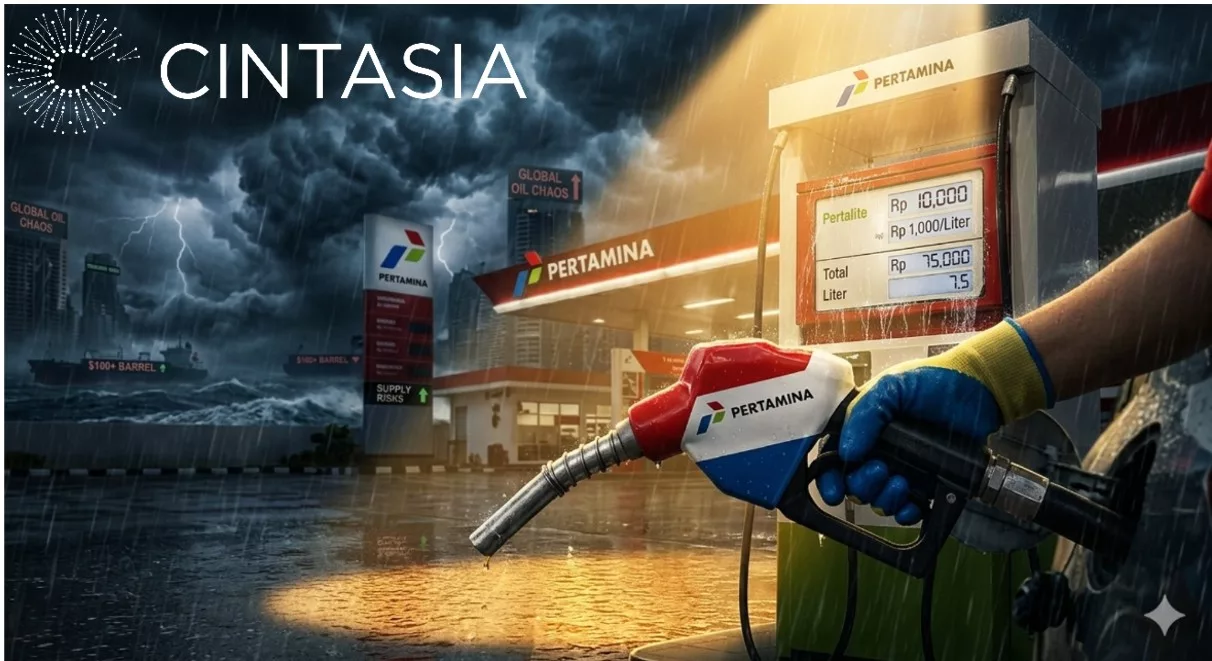
In recent weeks, global oil prices surged above $100 per barrel as conflict in the Middle East raised fears over the Strait of Hormuz.
Yet at Indonesian gas stations, fuel prices have remained stable.
The government deliberately chose to subsidize fuel and protect consumers.
Crude oil is raw petroleum extracted from the ground.
Refined products (gasoline, diesel, jet fuel, LPG) are what we actually use, along with thousands of everyday items like plastics, fertilizers, medicines, and cosmetics.
Oil powers far more than vehicles, planes, and ships. It is the invisible foundation of modern life.
Indonesia produces +/- 600,000 barrels of crude oil per day, ranking it roughly 20th in the world.
This is not enough to meet the country’s demand for finished refined products, which lies above 1,6 million barrels per day (of finished fuels).
Domestic refineries can only process enough crude to meet roughly 60% of this demand.
This is why Indonesia must import both large volumes of ready-to-use fuels and additional crude oil.
The Hormuz risk is real but currently well-managed.
Only 20-25% of Indonesia’s crude imports pass through the strait of Hormuz.
The rest comes from Africa (especially Nigeria and Angola), the USA, Brazil, Australia, … and does not go through the Hormuz Strait.
Domestic fuel stocks provide 3 weeks of supply.
The subsidy policy protects lower-income families from sharp increases in transport and cooking costs, preserving purchasing power and social stability.
The question about this subsidy is how long the government will maintain it, the extra cost in 2026 being estimated to 5-6 billion USD.
President Prabowo has announced the rollout of the B50 biodiesel starting July 1, 2026.
B50 will increase the palm oil content of biodiesel from 40% (B40) to 50%.
Reducing the need to import regular diesel fuel supports Indonesia’s own palm oil industry.
Indonesia is the world N°1 producer of palm oil, check this link to learn more.
Indonesia’s energy consumption mix:
Coal 40%
Oil 30%
Gas 16%
Others 14% (geothermal, hydro, solar, biomass)
The current crisis highlights the need to accelerate diversification of sources.
Recent steps include new energy cooperation agreements with Japan (gas and geothermal) and efforts to boost domestic production.
To protect both the economy and its people, the government should build larger strategic reserves and upgrade or build refineries.
In today’s volatile world, Indonesia is balancing short-term consumer protection with long-term energy independence.
How is your country faring?
Comment to bonjour@cintasia.com or on LinkedIn (link below).
We are CINTASIA; we help you develop your sales and operations in Indonesia, with a focus on Tech & Engineering.
We are an Alliance Partner of Asia-Connect Executive Partners
Solving Leadership Gaps & Business Challenges Across Asia
Picture: Gemini
Source: CintaGrok